Introduction: AI Search Engines
AI search engines are tools that reconstruct the information retrieval process through artificial intelligence technology. Their core breakthrough lies in shifting from "link aggregation" to "answer generation." These engines utilize natural language processing (NLP), machine learning (ML), and large language models (LLM) to directly parse user intent and provide structured answers, rather than traditional keyword matching results. Based on different technical architectures and application scenarios, AI search engines can be divided into two categories: Native AI search engines (designed specifically for AI search) and Large language models with web search integration (integrating web search functionality into existing conversation tools). For more detailed information about search engines, please check our Complete Guide to Search Engines.
AI Search Engine Technology Overview
Modern AI search engine technology is based on large language models (LLM), natural language processing (NLP), and machine learning (ML) technology, capable of understanding natural language queries, analyzing search intent, and generating structured answers with citation sources. Compared to traditional search engines, AI search engines have significantly improved in semantic understanding, answer generation, and personalization.
The core technical foundations of AI search engines include Natural Language Understanding (NLU), Information Retrieval (IR), Answer Generation, and Citation Management. Natural Language Understanding enables AI search engines to parse user queries, understanding search intent and context, rather than just matching keywords. Information Retrieval technology enables AI search engines to retrieve relevant information from massive data sources, while Answer Generation technology enables AI search engines to synthesize information and generate structured answers. Citation Management ensures that generated answers include source links, allowing users to verify information accuracy.
The core advantages of AI search engines lie in their understanding capabilities and generation capabilities. Understanding capabilities enable AI search engines to parse natural language queries from users, comprehend search intent and context, rather than just executing keyword matching. Generation capabilities enable AI search engines to create structured answers, not just return link lists. This combination of "understanding + generation" allows AI search engines to complete the entire process from query input to answer generation.
Different types of AI search engines adopt different technical architectures. Native AI search engines typically have self-built crawlers and real-time indexing systems, capable of independently acquiring and processing information; large language models with web search integration mostly call third-party search APIs, integrating web search functionality into existing conversation tools. Despite different technical architectures, these tools share a common characteristic: the ability to understand user queries and generate structured answers, rather than just returning link lists.
As AI technology continues to develop, the capabilities of AI search engines are continuously improving. Factors such as expanded model scale, increased training data, and algorithm optimization are all driving improvements in AI search engine answer quality. At the same time, the development of multimodal AI technology enables AI search engines to simultaneously understand text, images, and voice, further enriching search methods. These technological advances not only improve the answer quality of AI search engines but also expand their application scenarios, upgrading AI search engines from simple information retrieval tools to intelligent knowledge assistants.
Native AI Search Engines
Designed specifically for AI search, with "direct answer generation" as the core goal, typically possessing stronger semantic understanding and multimodal processing capabilities. Native AI search engines usually have self-built crawlers and real-time indexing systems, support multi-turn conversations and context understanding, and provide structured answers with citation sources.
Perplexity AI
Perplexity AI integrates large models like GPT-4 and Claude, crawls information from the entire web in real-time and generates answers with citation sources, supporting document uploads and multimodal search (such as image queries). Its "Focus Mode" can limit search scope (such as YouTube, academic papers), meeting deep research needs. Perplexity has a self-built crawler system, indexing over 1 billion web pages, and provides Pro subscription service ($20/month), making it a leading product in the AI search engine field.


Consensus
Consensus is an AI search engine focused on academic research, providing answers based on scientific paper databases. It can extract information from millions of academic papers, generate evidence-based answers, and provide complete citation sources. Consensus is particularly suitable for researchers, students, and professionals who need scientific evidence.
You.com
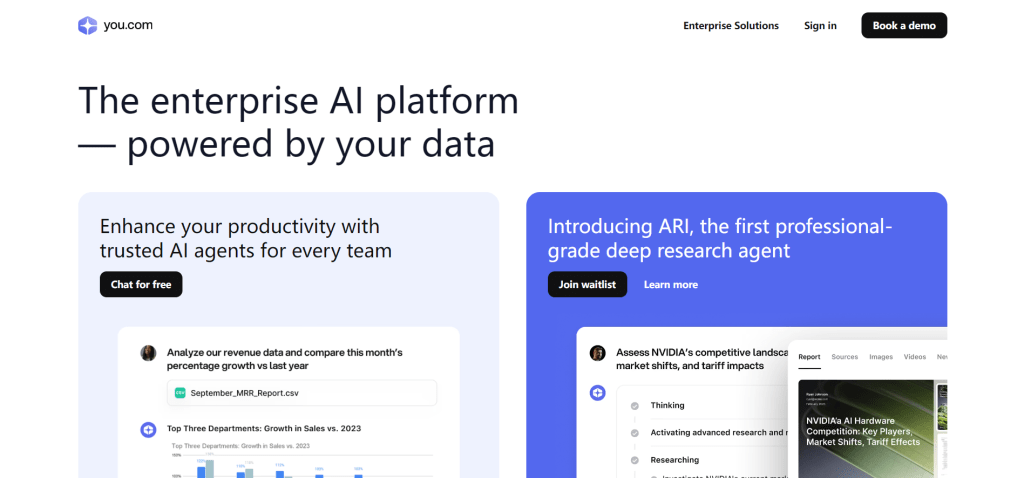
You.com emphasizes personalized experience, allowing users to customize AI model preferences (such as choosing different LLMs to generate answers), and provides visual charts and real-time news integration functions, suitable for multi-scenario information integration. You.com supports multiple search modes, including traditional search, AI conversation, and code search, providing users with flexible information acquisition methods.


Phind
Phind is a professional engine for developer communities, capable of parsing complex programming problems and generating code examples, while integrating technical documentation libraries (such as Stack Overflow), directly linking solutions with original discussions. Phind is particularly suitable for developers to search for technical problems, find code examples, and query documentation.
Felo AI
Felo AI breaks through traditional text output, supporting automatic conversion of search results into structured formats such as PPT slides and mind maps, and built-in academic paper translation tools, serving education and research scenarios. Felo AI is particularly suitable for users who need to organize search results into presentations or research reports.

Andi
Andi is a simple and easy-to-use AI search engine focused on providing fast and accurate answers. It adopts a conversational interface, supports natural language queries, and can understand complex questions and provide structured answers. Andi is particularly suitable for daily information queries and quick answer acquisition scenarios.
Large Language Models with Web Search Integration
Integrating web search functionality into existing search engines or AI conversation tools to expand application boundaries. These tools usually retain traditional search boxes and overlay AI functions, providing a dual mode of "traditional results + AI summary."
ChatGPT Search
ChatGPT Search is based on OpenAI's conversational model, with a new web search module, users can refine requirements through multi-turn conversations. The system combines context to generate answers with source links, especially good at handling open-ended long-tail questions. ChatGPT Search relies on Bing search API to obtain real-time information, providing web search functionality for ChatGPT Plus users.


Bing Copilot
Bing Copilot deeply integrates GPT-4 into Bing search, providing a dual mode of "traditional results + AI summary," supporting image analysis and multilingual real-time translation, becoming an efficient tool for enterprise office scenarios. Bing Copilot combines the comprehensiveness of traditional search results with the precision of AI summaries, supporting multi-turn conversations and context understanding, widely used in document analysis, data queries, and content creation scenarios.
Deepseek Web Search
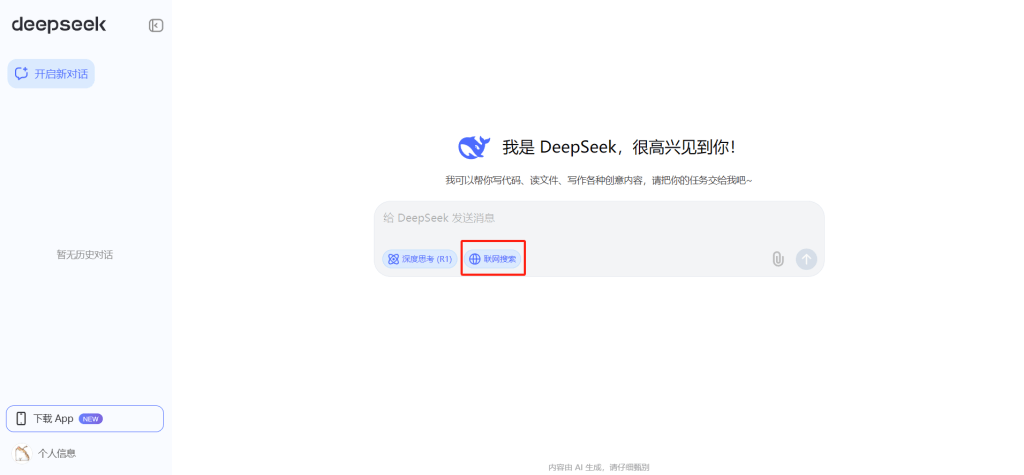
Deepseek is a web search function launched by China's leading AI large model company, supporting real-time information retrieval and context understanding, providing users with precise search experiences. Deepseek web search adopts advanced natural language processing technology, capable of understanding complex query intents, integrating multi-source information, providing structured search results and detailed analysis reports, widely used in research, learning, and work scenarios.

Grok DeepSearch
Grok is an AI assistant launched by xAI. Its DeepSearch function focuses on deep information retrieval and comprehensive analysis, capable of handling complex queries and reasoning about conflicting facts, providing concise reports. Grok DeepSearch adopts advanced reasoning capabilities, can explain its logical process, suitable for research, data analysis, and brainstorming scenarios, providing users with deeper information insights.
Other large models supporting web search: Including mainstream AI models like Claude and Gemini, all expand application boundaries by integrating web search functionality, providing users with more comprehensive information acquisition capabilities.
Core Differences Between Two Types of AI Search
| Comparison Dimension | Native AI Search Engines | Large Language Models with Web Search Integration |
|---|---|---|
| Data Acquisition | Rely on self-built crawlers and real-time indexing (e.g., Perplexity crawls 1B+ web pages) | Mostly call third-party APIs (e.g., ChatGPT relies on Bing search) |
| Interaction Logic | Tend towards "search as conversation" (chat-style interface) | Retain traditional search box and overlay AI functions (e.g., Google Gemini's answer summary module) |
| Commercialization | Mostly adopt subscription model (e.g., Perplexity Pro $20/month) | Profit through advertising or ecosystem binding (e.g., Bing integrates Microsoft 365 services) |
With breakthroughs in multimodal reasoning and deep semantic analysis technology, AI search may continue to differentiate: vertical fields (such as law, healthcare) rely on industry knowledge bases to build barriers, while general products achieve cross-platform task execution through Agents (intelligent agents), like Fellou and Arc.
Use Cases and Selection Guide
Deep Research and Academic Queries
For deep research and academic query scenarios, we recommend using native AI search engines, especially:
- Perplexity AI: Suitable for deep research requiring citation sources, supports document uploads and multimodal search. Its "Focus Mode" can limit search scope (such as academic papers, YouTube)
- Consensus: Specifically designed for academic research, provides evidence-based answers based on scientific paper databases, particularly suitable for researchers and students
- Felo AI: Can automatically convert search results into PPT slides and mind maps, suitable for scenarios requiring research result organization
Daily Information Queries and Quick Answers
For daily information queries and quick answer acquisition scenarios, you can choose large language models with web search integration:
- Bing Copilot: Provides a dual mode of "traditional results + AI summary," suitable for daily queries requiring comprehensive information
- ChatGPT Search: Suitable for multi-turn conversations to refine requirements, especially good at handling open-ended long-tail questions
- Deepseek Web Search: Excellent Chinese AI search experience, suitable for Chinese users for information queries
Professional Domain Queries (Development, Technology)
For developers and technical professionals, we recommend using specialized AI search engines:
- Phind: Professional engine for developers, capable of parsing complex programming problems and generating code examples, integrates technical documentation libraries (such as Stack Overflow)
- Grok DeepSearch: Focuses on deep information retrieval and comprehensive analysis, capable of handling complex queries and reasoning about conflicting facts
Personalized Search Experience
For users who need personalized search experiences:
- You.com: Allows users to customize AI model preferences, provides visual charts and real-time news integration functions, suitable for multi-scenario information integration
- Andi: Simple and easy-to-use conversational interface, suitable for daily information queries and quick answer acquisition
Selection Recommendations
When choosing an AI search engine, consider the following factors:
- Use case: Choose native AI search engines for deep research, choose large language models with web search integration for daily queries
- Feature requirements: Evaluate whether specific features are needed, such as multimodal search, document upload, citation sources, etc.
- Data sources: Native AI search engines usually have self-built crawlers and real-time indexing, integrated types mostly call third-party APIs
- Cost-effectiveness: Compare pricing of different tools and choose the plan that best fits your budget
- Privacy protection: For scenarios involving sensitive data, choose tools that focus on privacy protection
It's recommended to try free versions of several tools first, then make the final choice based on actual experience. For important information, it's recommended to use multiple AI search engines for cross-verification to ensure answer accuracy.
How to Get Started with AI Search Engines
Getting started with AI search engines is very simple, and most tools provide user-friendly interfaces and detailed usage guides. First, clarify your search needs, determining what type of information you want to search for (deep research, daily queries, professional domain queries, or personalized search). Then, choose the right tool, selecting the most suitable AI search engine based on your needs, use case, and budget.
Next, register an account and familiarize yourself with the interface. Most AI search engines offer free versions, so you can register an account first to get familiar with the tool's interface and basic functions. Then, start with simple queries, using natural language to ask questions, gradually understanding how AI search engines understand and answer queries. Finally, learn advanced features, such as multimodal search, document upload, citation sources, etc., to make full use of AI search engine capabilities.
For beginners, it is recommended to start with simple queries and gradually explore advanced features. You can refer to the examples and tutorials provided by the tool to learn search techniques and best practices. At the same time, join the tool's community to communicate and learn with other users, sharing experiences and tips. As you accumulate experience, you will be able to use AI search engines more proficiently and obtain more accurate and comprehensive answers.
When using AI search engines, it's important to verify important information. Although AI search engines can generate structured answers, they may still produce errors or inaccurate information. For important decisions, it's recommended to verify AI-generated answers by checking citation sources or using multiple search engines for cross-verification. Additionally, pay attention to the timeliness of information, as AI search engines may not always obtain the latest real-time information.
Future Trends of AI Search Engines
The future development trends of AI search engines are mainly reflected in the following aspects: 1. Smarter understanding capabilities: As AI technology continues to develop, AI search engines will be able to understand user queries more accurately, including implicit intentions and complex multi-turn conversations; 2. More accurate answer generation: AI search engines will be able to generate more accurate and comprehensive answers, with better citation management and source verification; 3. Stronger multimodal capabilities: AI search engines will be able to simultaneously process text, images, voice, and video queries, providing richer search experiences.
Vertical domain specialization is also an important trend. While general AI search engines are powerful, they may not be as precise as specialized tools in specific fields. In the future, more AI search engines targeting specific industries and scenarios will emerge, such as legal search engines, medical search engines, academic search engines, etc. These tools will combine industry knowledge bases and domain expert experience to provide more professional and accurate services.
Intelligent agent integration is another important trend. AI search engines will be able to integrate with intelligent agents (Agents), enabling cross-platform task execution and automated information processing. For example, AI search engines can automatically analyze search results, generate reports, create presentations, etc., further simplifying user workflows.
At the same time, privacy protection and data security will become increasingly important. As AI search engines become more widely used, users' concerns about data privacy and security will also increase. Future AI search engines will need to provide stronger privacy protection measures, such as local processing, encrypted queries, and data anonymization, to protect user privacy while providing high-quality search services.
In addition, the cost of AI search engines will continue to decrease, making them more affordable for more users. As technology matures and competition intensifies, AI search engine pricing will become more reasonable, and free version features will become more complete. This will further lower the barrier to using AI search engines, allowing AI technology to benefit more users.
Conclusion
The recommended AI search engines excel in their respective fields, providing users with powerful information retrieval and answer generation capabilities. Native AI search engines (such as Perplexity, Phind) focus on deep research and professional queries, providing structured answers with citation sources; large language models with web search integration (such as ChatGPT Search, Bing Copilot) combine traditional search and AI capabilities, providing more comprehensive information acquisition experiences. Choosing the right AI search engine can be decided based on specific needs, use cases, and budget. For more detailed information about search engines, please check our Complete Guide to Search Engines.