AI Search Engines: Intelligent Search and Direct Answers
Key Takeaways
This guide explores the best AI search engines for 2026, helping users choose the right solution. It also covers selection criteria, comparisons, and practical tips for implementation. The sections below compare options, use cases, and practical selection criteria. The sections below compare options, use cases, and practical selection criteria.
- AI search engines support intelligent search and direct answer generation for research and retrieval.
- Compare Perplexity, Phind, You.com, Consensus, ChatGPT Search, Bing Copilot for features and use cases.
- Consider answer quality, citation reliability, multimodal capability, and ease of use.
- Learn about technical principles and workflows with knowledge bases and text generators.
What Are AI Search Engines
AI search engines shift from link aggregation to answer generation. They use NLP and LLMs to parse intent and return structured answers with citations. They are not the same as AI browser tools: browsers render pages and may run agents; search services retrieve and synthesize web information (including in classic SERPs with AI summaries). Suited for research, knowledge discovery, and quick fact-finding.
In the workflow, AI knowledge base tools handle knowledge capture; AI text generators handle writing.
For programmatic web retrieval (Web Search API / search engine API) to ground LLMs and build RAG pipelines—not end-user search apps—see the dedicated Web Search API guide.
How AI Search Engines Work
AI search engines integrate NLP, knowledge graphs, and deep learning. They understand queries and retrieve relevant results. Versus keyword search, they improve relevance and natural interaction.
- Natural language understanding: Deeply understanding query context and intent, enabling natural language queries without keyword optimization.
- Structured answers: Providing precise, structured answers with citations, eliminating the need to click through multiple results.
- Knowledge graph integration: Integrating knowledge graphs to understand relationships between concepts, providing comprehensive answers.
- Real-time synthesis: AI-powered synthesis of information from multiple sources, creating coherent and accurate answers.
- Source citations: Providing source citations for transparency and verification, enabling users to verify information.
From a technical perspective, AI search engines usually follow two main architectures—native answer-first products vs. integrated web search inside chat LLMs—while legacy search engines may add AI Overviews or AI Mode on top of existing indexes. Developer-facing retrieval APIs are a separate procurement path from end-user search apps.
Native AI Search Engines
Native AI search engines are built specifically for AI-powered search, providing comprehensive search experiences with proprietary crawlers and indexes.
1. Perplexity: AI Search Pioneer

Perplexity leads as a native AI search engine, providing LLM-powered intelligent search with real-time web data and source citations. It supports conversational queries, document uploads, and personalized search, excelling in deep research and academic inquiries with structured answers and reliable references.
2. Phind: Developer-Focused AI Search

Phind specializes in AI search for programmers and developers, using the Phind model for precise technical queries. It excels in code search, API documentation, and programming problem solutions, making it essential for software development and technical workflows.
3. You.com: Personalized AI Search

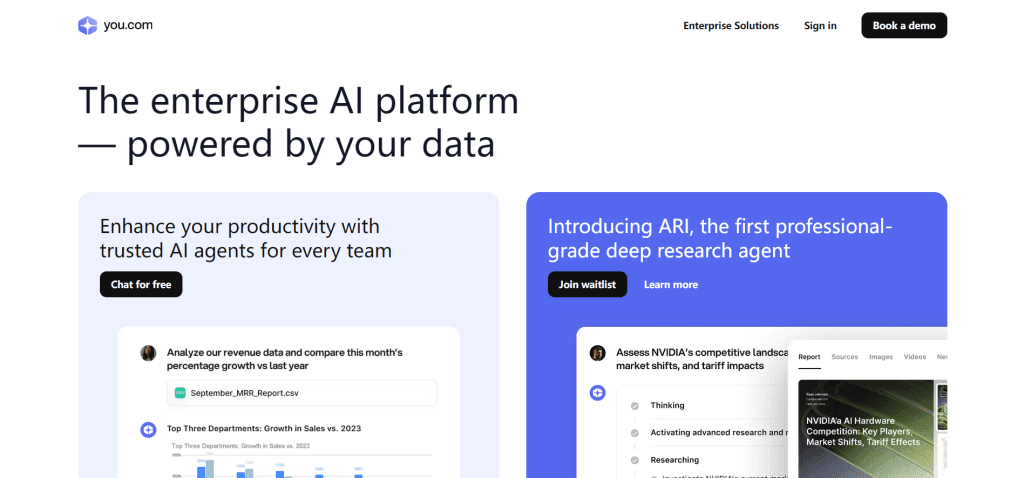
You.com prioritizes privacy with personalized search experiences and multi-model support. Through AI preference analysis, it delivers customized results and answers, supporting image search and multilingual interfaces for enhanced user experience.
4. Consensus: Academic Research Focused
Consensus specializes in academic AI search, searching millions of papers for evidence-based answers. It supports multidisciplinary queries, paper citations, and research trend analysis, making it indispensable for scholars and researchers.
5. Felo AI: Chinese-Optimized AI Search
Felo AI optimizes for Chinese users with fluent dialogue and precise Chinese search results. It supports mixed Chinese-English queries and localized content search, making it ideal for Chinese users and Asian markets.
6. Liner: AI Research Assistant

Liner is an AI-powered research assistant that delivers the most accurate and reliable search results for academic and professional research. It features multi-agent intelligence that generates testable hypotheses, scans over 460 million academic papers, and provides citation-ready insights. Every answer includes line-by-line precision with sources, deep research capabilities with clear reasoning, and Scholar Mode for automatic citation formatting. Used by 12M+ scholars worldwide, Liner prioritizes data control and privacy, giving users full ownership of their research data. For researchers, academics, and professionals requiring verifiable, source-backed information, Liner provides the highest accuracy among AI search engines with enterprise-grade security.
Integrated AI Search in LLMs
Integrated AI search incorporates web search capabilities into large language models, providing intelligent search experiences within conversational AI tools.
1. ChatGPT Search: GPT Integrated Search

ChatGPT Search integrates web search into ChatGPT, providing answers based on current information through GPT models and real-time data access. It supports conversational queries and knowledge updates, making it ideal for queries requiring the latest information.
2. Bing Copilot: Microsoft AI Search

Bing Copilot integrates Bing search with GPT models for intelligent experiences, leveraging Bing's powerful indexing and GPT understanding. It supports web search, image search, and creative generation, making it ideal for comprehensive information needs.
3. Deepseek Web Search: Open-Source AI Search

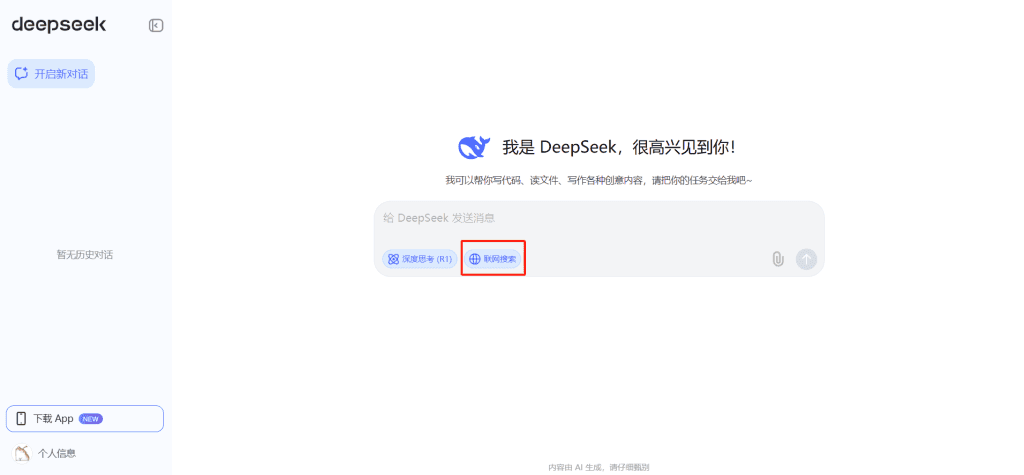
Deepseek Web Search integrates web search into Deepseek's open-source models, providing intelligent search experiences. It offers open-source technology advantages with customizable models and local deployment, perfect for privacy-conscious users.
4. Claude Search: Anthropic Integrated Search

Claude Search integrates web search into Claude models using Anthropic's safe AI technology. It provides intelligent search experiences supporting complex queries with ethically-oriented answer generation, ideal for users needing high-quality, reliable answers.
5. Gemini Search: Google AI Search

Gemini Search integrates Google search with Gemini models, leveraging Google's powerful search and Gemini's multimodal understanding for comprehensive experiences. It supports text, image, and video search, perfect for multimodal information needs.
6. Grok Search: xAI Native Search
Grok Search is xAI's native AI search engine, providing humorous yet practical search experiences based on the Grok model. It supports real-time information queries with xAI's unique humorous style, perfect for users seeking entertaining interactions.
AI Search Engines Comparison
Here's a detailed comparison of the top AI search engines to help you choose the best solution for your needs:
| Tool Name | Core Features | Best For | Pricing | Integrations |
|---|---|---|---|---|
| Perplexity | Real-time search, source citations | Deep research | Free + Pro | Native AI Search |
| Phind | Code search, technical queries | Developers | Free + Subscription | Native AI Search |
| You.com | Privacy protection, personalization | Daily queries | Free + Premium | Native AI Search |
| Consensus | Academic search, paper citations | Academic research | Free + Subscription | Native AI Search |
| Felo AI | Chinese optimization, localization | Chinese users | Free + Membership | Native AI Search |
| ChatGPT Search | GPT model, real-time information | General queries | ChatGPT Plus | Integrated AI Search |
| Bing Copilot | Microsoft ecosystem, multimodal | Enterprise users | Free + Premium | Integrated AI Search |
| Deepseek Web Search | Open-source technology, customizable | Developers | API billing | Integrated AI Search |
| Claude Search | Safety and reliability, ethical focus | Professional users | Claude Pro | Integrated AI Search |
| Gemini Search | Google ecosystem, multimodal | General search | Free + Subscription | Integrated AI Search |
| Grok Search | Humorous style, real-time information | Entertainment users | Free | Integrated AI Search |
How to Choose AI Search Engines
Selecting AI search engines requires considering use cases, technical features, privacy protection, and more. Here are 5 key steps for optimal choice.
1. Define Purpose and Use Cases
First determine primary AI search needs and scenarios: academic research requires citation processing and scholarly sources; code search needs programming-focused results; daily learning benefits from comprehensive queries across diverse topics. Different tools excel in different areas, so choose based on specific use cases and primary search patterns.
2. Evaluate Data Sources and Timeliness
AI search data sources directly affect result quality and reliability. Native AI search engines typically have proprietary crawlers and indexes for real-time network information, ensuring up-to-date results. Integrated AI search LLMs depend on third-party APIs for timeliness, which may introduce delays. Choose reliable, regularly updated AI search engines ensuring accurate, practical results for various needs.
3. Check Citations and Transparency
Excellent AI search engines provide detailed source citations and transparency for users to verify accuracy and reliability. Good engines label sources, update times, and provide verification methods. Cross-check important answers and consider systematic quality reviews with AI evaluation workflows where teams need repeatable benchmarks. Citation transparency remains central to trust.
4. Consider Privacy and Data Security
Privacy protection and data security are crucial in the digital age. Understand AI search data policies, privacy measures, and storage methods, choosing user privacy and data security-focused tools. Excellent AI search engines use encryption and anonymization for user search privacy protection. Evaluate privacy policies as key for selecting AI search engines, ensuring personal data and habits aren't misused or leaked.
5. Test Multimodal and Integration Capabilities
Modern AI search engines support text, image, audio, video input/output beyond text. Evaluate multimodal processing and integration capabilities: test image search accuracy, audio transcription quality, and video understanding. Test AI search multimodal abilities and integration to ensure complex needs are met. Choose comprehensive, integrated AI search engines for efficiency and experience, meeting diverse information needs.
Conclusion
AI search engines represent a major breakthrough in information retrieval, shifting from traditional keyword matching and link aggregation to AI-powered answer generation. Tools like Perplexity, Phind, and Consensus provide exceptional precision, personalization, and efficiency in search experiences through deep integration of natural language processing, knowledge graphs, and real-time data processing.
Choose appropriate AI search engines based on specific needs, technical requirements, data reliability, and cost-effectiveness. Academic researchers benefit from Consensus's literature retrieval, programmers prefer Phind's technical search, enterprise users integrate Bing Copilot into workflows. Evaluate use cases, feature requirements, privacy needs, and budget constraints to select the most suitable AI search solution.
AI search engines serve as powerful assistants that enhance information acquisition efficiency, but they complement rather than replace human critical thinking and verification. The best approach is human-AI collaboration: AI handles information retrieval and initial synthesis, while humans provide critical analysis, source verification, and strategic interpretation, maximizing both search efficiency and information quality. For visibility when your content is cited inside AI-generated answers, align publishing with GEO (generative engine optimization).