What are Search Indexing Tools
Search indexing tools help website administrators submit URLs to search engines and notify them of page updates or deletions. Traditional submission methods require manual submission in Search Console, which is inefficient. Indexing tools automate submissions through APIs or protocols, significantly improving efficiency.
Common indexing tools include official tools like Google Indexing API, Bing Indexing API, and IndexNow protocol, as well as third-party tools like IndexJump and Indexly. These tools enable bulk URL submission and automated index management. For website submission guidance, see our website submission guide.
Push Indexing vs Pull Indexing
Search indexing methods are divided into Push and Pull indexing. Understanding their differences helps choose the best indexing strategy. According to Albin's Blog research, here's a detailed comparison: According to Albin's Blog research, here's a detailed comparison:
Pull Indexing (Traditional)
Pull indexing is the traditional method where search engine crawlers (Googlebot, Bingbot) periodically visit websites, follow links, and crawl content to build indexes. This method relies on crawl budget and frequency, and site owners cannot control indexing speed.
Pull indexing characteristics include: content type is typically unstructured (web pages, PDFs); update frequency is low to medium, scheduled periodic crawling; control is limited, mainly relying on external public content; latency sensitivity is low, no real-time indexing needed; security and access involve public or API-based access; implementation is typically configuration-driven, no code required.
Pull indexing suits static or infrequently updated content like blog posts, FAQ pages, and evergreen content. It requires no configuration as search engines automatically discover and crawl. It's suitable for public-facing marketing websites, blogs, or news sites. However, it's slow for new content discovery (days or weeks), depends on crawl budget, and cannot guarantee immediate updates.
Push Indexing (Modern)
Push indexing is the modern method where websites actively notify search engines of URL changes through APIs or protocols like IndexNow, enabling real-time updates and fast indexing.
Push indexing characteristics include: content type is typically structured (products, articles); update frequency is high, real-time updates; control is full control (via CMS, DB, PIM systems); latency sensitivity is high, fast indexing needed; security and access involve internal or private systems; implementation requires development work, API setup needed.
Push indexing offers fast discovery, immediately notifying search engines of URL changes. It's ideal for real-time content like e-commerce products, news, and dynamic content. It doesn't depend on crawl budget and allows bulk submission of many URLs. It's suitable for e-commerce product updates, internal CMS-driven knowledge bases. However, it requires API integration and management, and needs API key maintenance.
Push vs Pull Detailed Comparison
| Criteria | Push Indexing | Pull Indexing |
|---|---|---|
| Content Type | Structured (products, articles) | Unstructured (pages, PDFs) |
| Update Frequency | High, real-time | Low to medium, scheduled |
| Control Over Source | Full control (CMS, DB, PIM) | Limited (external/public content) |
| Latency Sensitivity | High | Low |
| Security & Access | Internal/private systems | Public or API-based access |
| Implementation | Requires development, API setup | Config-driven flow, no code |
Use Case Recommendations
| Use Case | Recommended | Notes |
|---|---|---|
| E-commerce product updates | Push | Frequent product changes, real-time indexing needed |
| Internal CMS-driven knowledge base | Push | Content managed by CMS, can actively push |
| Public-facing marketing website | Pull (Crawler) | Relatively stable content, crawlers can auto-discover |
| Blog or news site | Pull (Sitemap) | Help crawlers discover new content via sitemap |
| Syndicated or partner content via API | Pull (Connector) | Get external content via API connectors |
| User-generated content | Push | Frequent content changes, fast indexing needed |
Platform Examples
Different search platforms adopt different indexing strategies:
- Coveo: Pull-first, built-in connectors (Salesforce, SharePoint, REST), also supports Push via API
- Algolia: Push-first, SDK/API-driven, no crawler
- Azure Search: Both, supports indexers (Pull) and REST API (Push)
- MeiliSearch: Push-first, lightweight, JSON-focused
Hybrid Strategy
Best practice is a hybrid approach: use Push indexing for critical, fresh content (new articles, updated product pages) via IndexNow or Indexing API for fast notification. Use Pull indexing for foundational, infrequently updated pages (about pages, privacy policies) relying on traditional crawling. This hybrid method ensures fast indexing for important content while leveraging search engines' automatic discovery capabilities.
Push Indexing Value for GEO Optimization
GEO (Generative Engine Optimization) optimizes content visibility in AI search engines like ChatGPT, Perplexity, and Claude. Push indexing significantly boosts AI search visibility.
Push indexing quickly notifies search engines of URL changes, enabling AI search engines to access the latest content promptly. When websites publish or update content, immediate notification via IndexNow or Indexing API allows AI search engines to discover and index content faster, providing more timely and accurate information in AI responses.
For GEO optimization, Push indexing enhances AI search visibility, ensuring content is cited in ChatGPT and Perplexity responses. It accelerates content discovery, enabling faster indexing of new content by AI search engines. It improves content freshness, allowing AI search engines to access the latest updates for more accurate answers. Combined with website structure optimization and internal linking strategies, Push indexing maximizes GEO optimization effectiveness.
Official Indexing Tools
Official indexing tools are provided directly by search engine providers. For most websites, IndexNow protocol is the best choice for its simplicity, no quota limits, and multi-search engine support. Google Indexing API is only applicable to job posting and live video websites.
IndexNow Protocol (Recommended)
IndexNow is an open protocol initiated by Microsoft Bing and supported by Google, Yandex, and other search engines. It allows websites to notify search engines of URL changes via simple HTTP requests without complex OAuth authentication. Setup includes generating an API key, saving it as a text file in the website root directory, and submitting URLs via HTTP GET or POST requests.
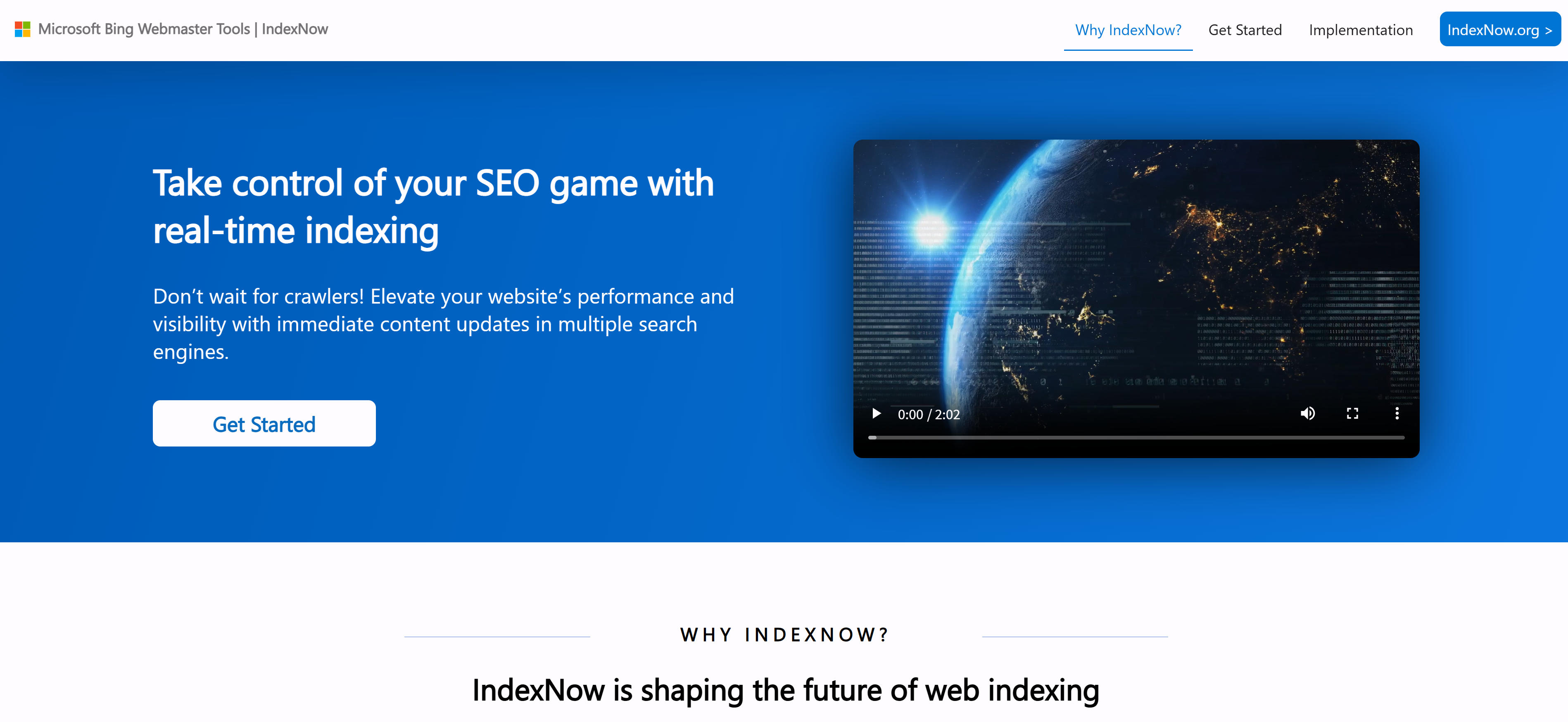
IndexNow advantages include simplicity, multi-search engine support, no quota limits, and free use. For most websites, IndexNow is the best choice, especially for sites needing bulk submission of many URLs. One submission can notify Google, Bing, Yandex, and other search engines.
Bing Indexing API
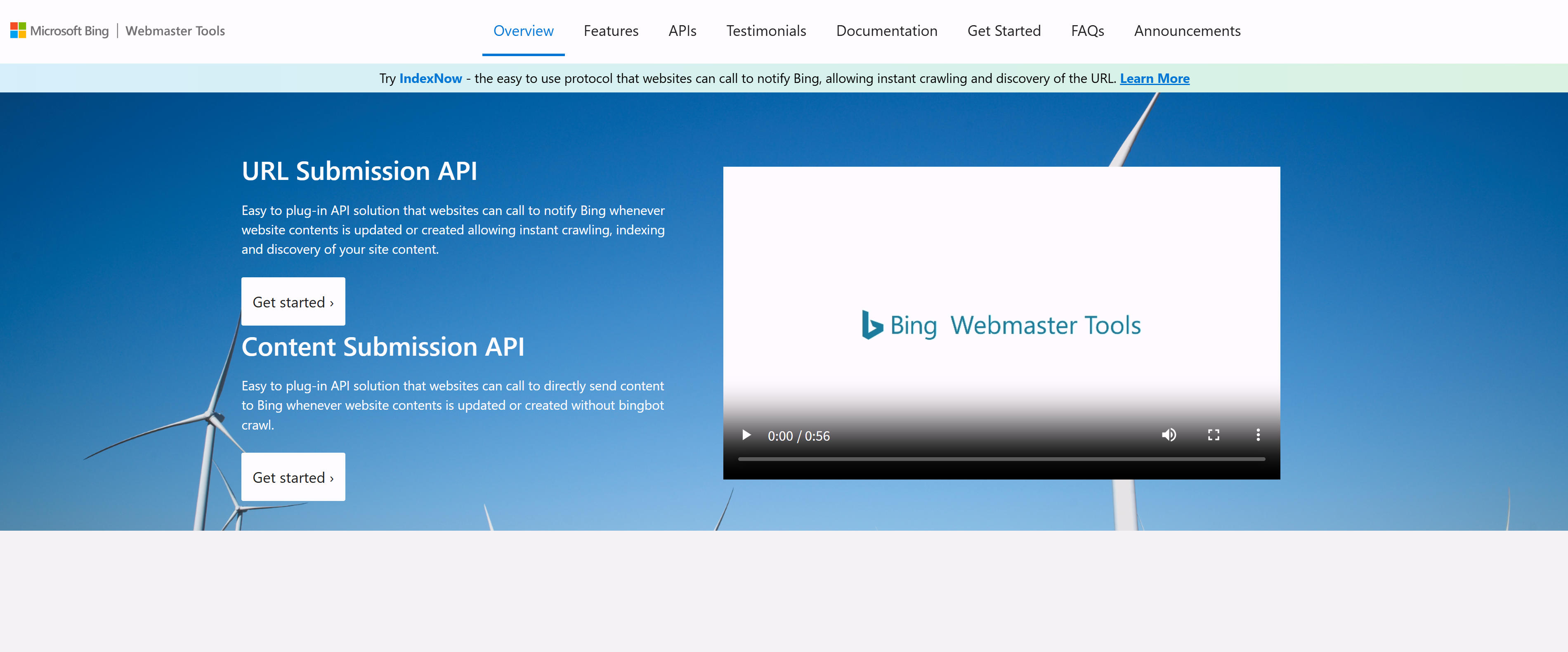
For Bing-focused websites, Bing Indexing API is ideal. However, IndexNow protocol is recommended as it's simpler and supported by multiple search engines, allowing one submission to notify multiple engines.
Bing Indexing API is Bing's official API supporting bulk URL submission to Bing search engine. Setup includes registering and verifying websites in Bing Webmaster Tools, generating API keys, and configuring API access permissions. Similar to Google Indexing API, it requires API key authentication.
Google Indexing API (Job Postings & Live Videos Only)
Important Limitation: Google Indexing API currently only supports pages containing JobPosting (job listings) or BroadcastEvent (live videos, nested in VideoObject). Regular website content cannot use this API. This is a restriction Google has set to prevent API abuse.
If your website contains job postings or live video content, Google Indexing API allows developers to programmatically submit URLs to Google. The API supports submitting new, updated, or deleted URLs using OAuth 2.0 authentication, requiring Google Cloud project and service account setup. The API limits to 200 URLs per day, suitable for websites with many short-lived pages (job postings or live videos).
Kostja is looking for images
Google Indexing API provides precise index control, supporting URL_UPDATED and URL_DELETED notification types. However, it only applies to job posting and live video websites; regular website content cannot use it. For most websites, IndexNow protocol is more recommended. See Google's official documentation for setup steps.
Third-Party Indexing Tools
Third-party indexing tools provide advanced features and better user experience, including bulk submission, fast indexing, and AI search engine optimization. These tools are ideal for websites needing rapid indexing of many pages or AI search visibility optimization.
IndexJump
IndexJump focuses on fast URL submission and indexing, providing bulk submission features to help websites quickly submit many pages to search engines. The tool supports AI search engine indexing needs like OpenAI, understanding special indexing mechanisms. Suitable for websites needing rapid indexing of many pages, especially e-commerce sites and content publishing platforms.
IndexJump's strength lies in understanding AI search engine indexing needs, enabling targeted submission strategy optimization. The tool provides detailed indexing monitoring and analysis features, helping users understand indexing status and effectiveness. For websites needing improved AI search visibility, IndexJump is an ideal choice.
Indexly
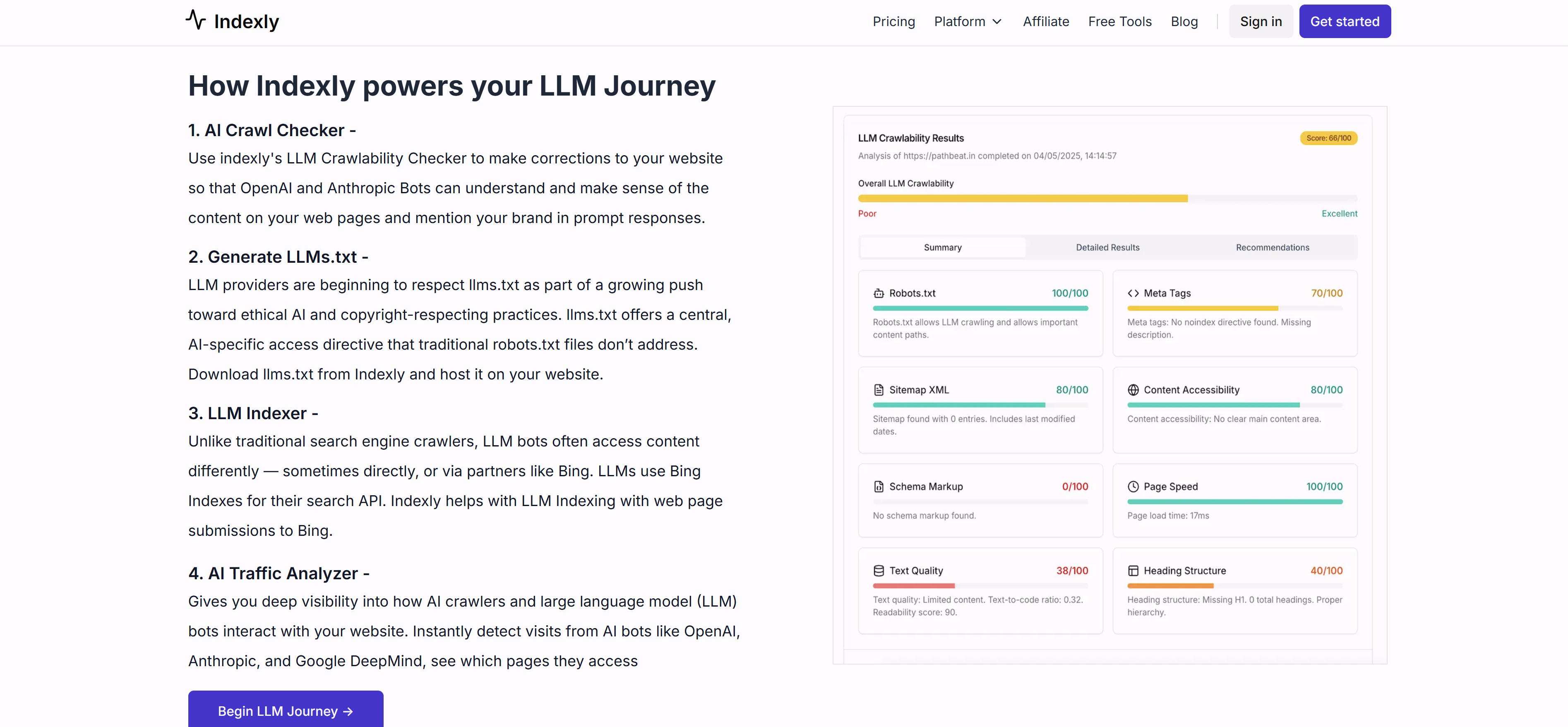
Indexly's AI-driven features automatically analyze content quality, keyword density, structured data, and other factors to optimize submission strategies. The tool provides detailed indexing analysis reports, helping users understand indexing effectiveness and improvement directions. For websites needing refined index management, Indexly offers professional-grade solutions.
Indexly is an AI-driven search indexing tool providing intelligent bulk submission, indexing monitoring, and AI search engine optimization. The tool uses AI to analyze content features, optimize submission strategies, and improve indexing success rates. Suitable for AI/SaaS products and websites needing improved AI search visibility.
SEOClarity AI Search Indexer
SEOClarity AI Search Indexer is SEOClarity's AI search indexing tool, focusing on AI search engine indexing and bulk submission. The tool provides indexing analysis features, helping users understand indexing status and issues. Suitable for websites needing AI search ranking optimization, especially content marketing and SEO optimization teams.
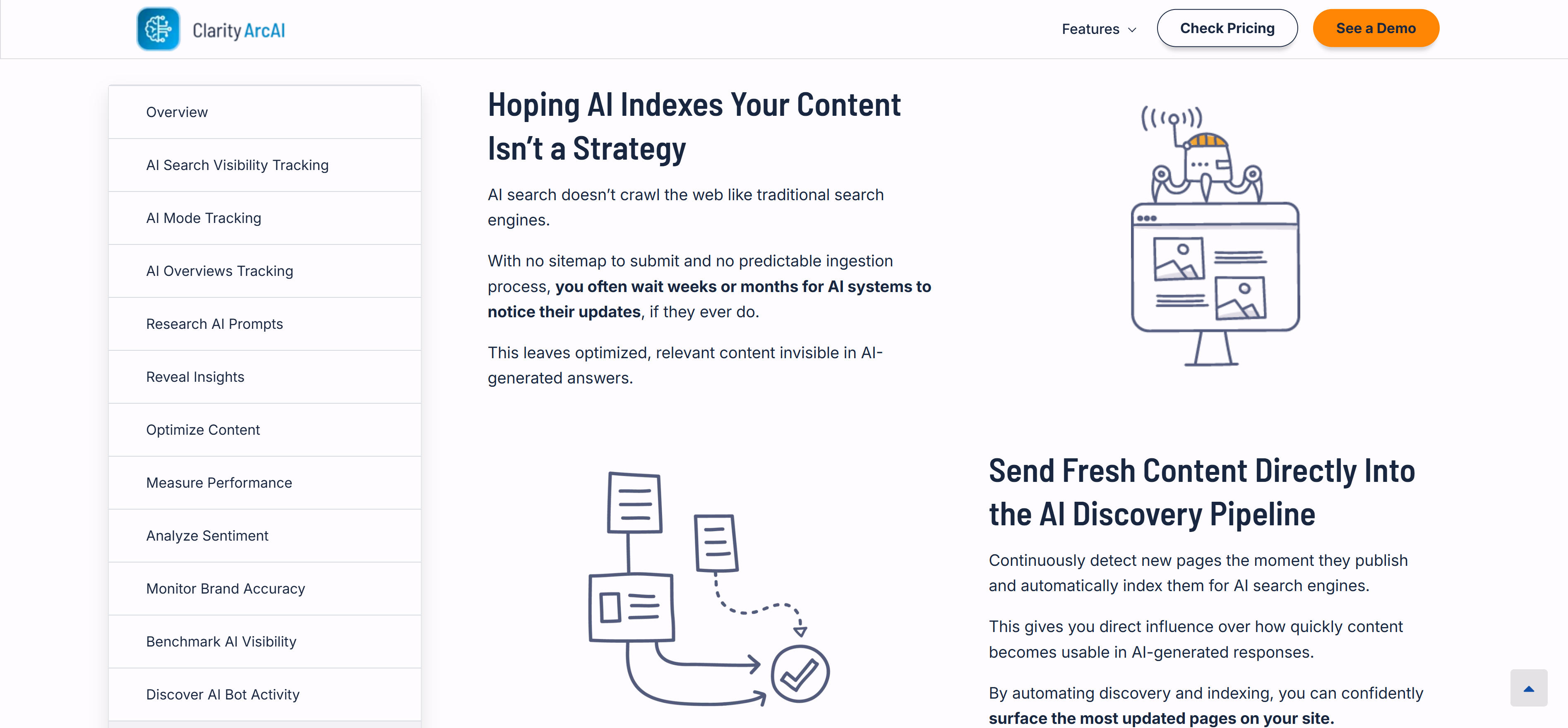
SEOClarity AI Search Indexer integrates into SEOClarity's SEO workflow, providing a one-stop SEO and indexing management solution. The tool provides detailed indexing analysis reports, including indexing coverage, speed, and quality metrics. For teams needing comprehensive SEO solutions, SEOClarity offers a complete toolchain.
TrySight
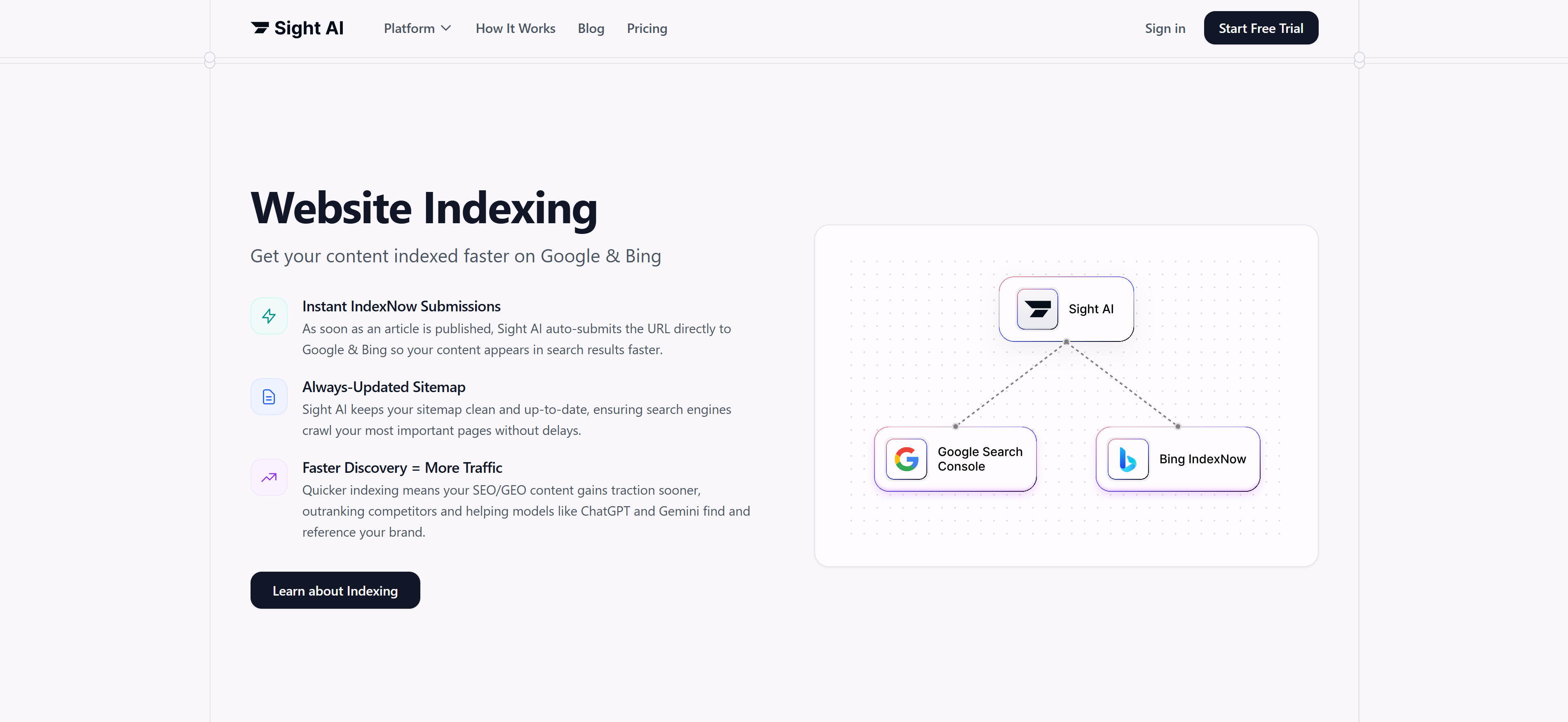
TrySight's strength lies in integrating indexing features into complete SEO workflows, providing a one-stop SEO management platform. The tool provides detailed indexing monitoring and analysis features, helping users understand indexing status and effectiveness. For teams needing unified SEO and indexing management, TrySight offers convenient solutions.
TrySight provides indexing features in an SEO tool, integrating URL submission, indexing monitoring, and indexing analysis into SEO workflows. The tool provides bulk submission features, supporting multiple search engines including traditional and AI search engines. Suitable for websites needing comprehensive SEO solutions, especially those needing to optimize both traditional and AI search.
How to Choose Indexing Tools
Choosing the right indexing tool requires considering multiple factors including website size, update frequency, technical capabilities, and target search engines. Key considerations:
- Assess website size and update frequency:Small websites with low update frequency can use IndexNow or Google Search Console manual submission. Large websites with frequent updates need bulk submission tools like IndexNow API or third-party tools. E-commerce sites with many product pages need specialized bulk submission tools.
- Consider technical capabilities and resources:Websites with technical teams can use IndexNow API for automated submission. Websites without technical teams can use third-party tools offering user-friendly interfaces and automation. Third-party tools typically offer more features but require paid subscriptions. Note: Google Indexing API only applies to job posting and live video websites.
- Determine target search engines:If multiple search engines need coverage, IndexNow is the best choice. If focusing on AI search engines (ChatGPT, Perplexity), use third-party tools supporting AI search. For job posting and live video websites, consider using Google Indexing API.
- Evaluate budget and tool costs:Official tools (Google Indexing API, IndexNow) are completely free but require technical capabilities. Third-party tools offer more features but require paid subscriptions. Choose tools based on budget and needs, with small websites prioritizing free tools.
- Consider tool features and integration capabilities:If detailed indexing analysis and monitoring are needed, third-party tools provide richer features. If integration with existing CMS or workflows is needed, choose tools supporting APIs. Evaluate whether tool features meet needs to avoid over-investment.
Considering these factors, most websites recommend IndexNow protocol for its simplicity, no quota limits, and multi-search engine support. For websites needing advanced features and AI search optimization, consider third-party tools. Regardless of tool choice, combine with website structure optimization and internal linking strategies for comprehensive SEO optimization.
Best Practices
When using search indexing tools, follow these best practices to maximize indexing effectiveness:
- Submit only important pages:Don't submit all pages, only submit new, updated, or deleted important pages. Prioritize high-value content like product pages, blog articles, and key feature pages.
- Avoid duplicate submissions:Don't repeatedly submit the same URLs, avoiding quota waste and triggering limits. Implement URL deduplication to ensure each URL is submitted only once.
- Monitor submission results:Regularly check Search Console to confirm URLs are successfully indexed. Use indexing tool monitoring features to track indexing status and effectiveness.
- Use quotas wisely:For Google Indexing API (job postings and live videos only), allocate the daily 200 URL quota wisely. IndexNow protocol has no quota limits and can be used freely.
- Combine with other optimizations:Indexing tools are supplementary; also optimize website structure, internal links, and external links. Ensure high content quality, clear structure, and reasonable linking.
- Implement error handling:Implement error handling and retry mechanisms to ensure submission reliability. For failed submissions, log error information and retry, avoiding missing important pages.
- Special considerations for GEO optimization:For GEO optimization, prioritize Push indexing to quickly notify AI search engines of content updates. Ensure content is structured and semantically clear, improving AI search engine understanding and citation rates.
For more information on website submission and indexing optimization, see our website submission guide.